bubble pop
Designing a pixel-themed casual game for stress relief, focus, and play with ai as dev team
role
AI Product Designer
tools
Emergent AI, Claude + VS code
team
Solo
timeline
2 Days

the problem space
Casual games are usually designed around increasing engagement through difficulty and reward. But they rarely account for emotional intent. Sometimes you want stimulation and challenge. Other times you want something repetitive and calming.
Most products don’t adapt to this difference. They lock users into a single emotional mode.
This raised a question: could one interaction system support multiple emotional experiences simply by changing system rules, without introducing complexity?
At the same time, I wanted to explore a second question: how far could I go in translating product intent into a working system by directing AI, instead of manually building everything myself?
Hypothesis and design principles
Brainstorming system behaviors and emotional modes
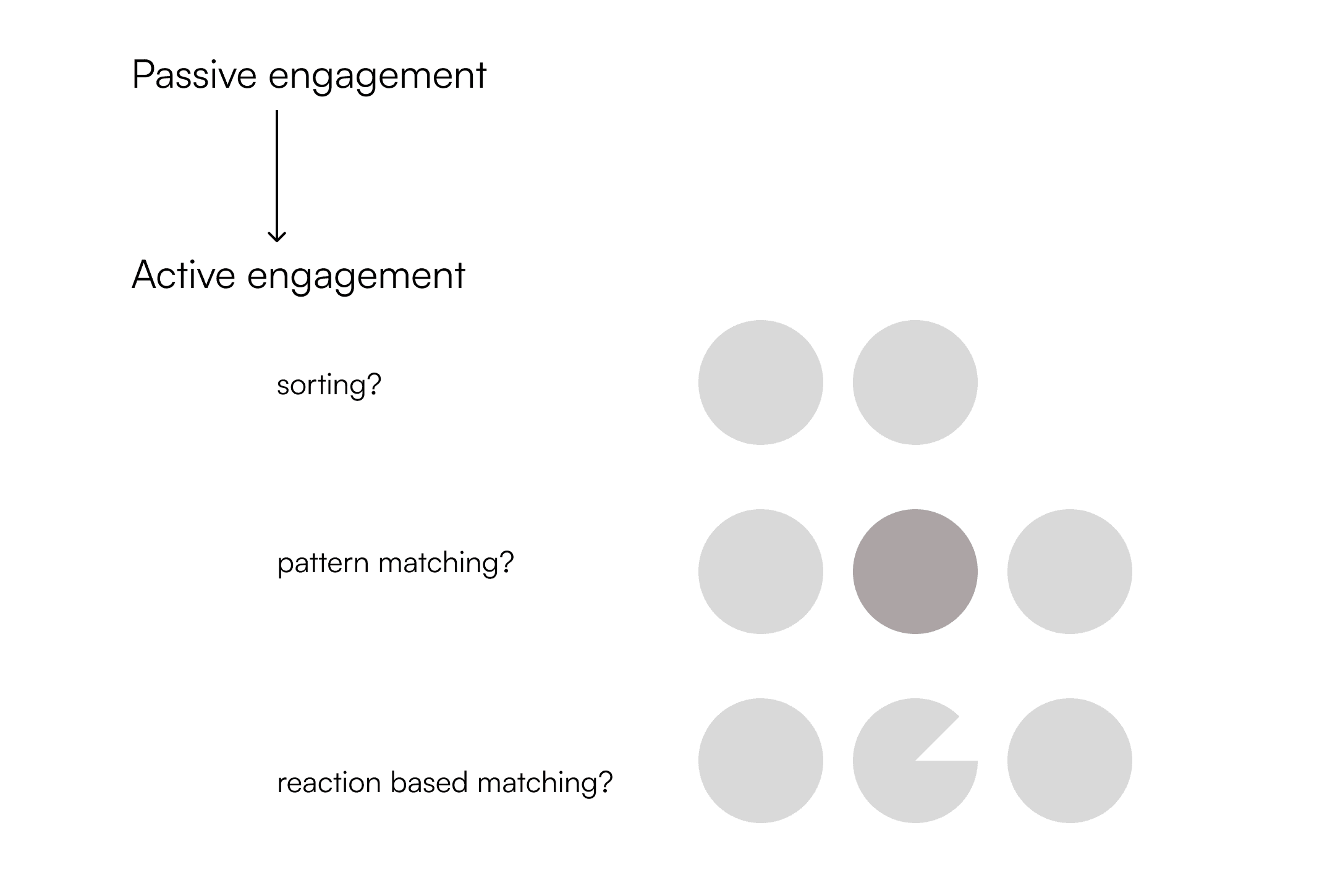
I explored interactions that could shift between passive and active engagement without adding complexity. I considered sorting, pattern matching, and reaction-based mechanics, but many required too much explanation or depended on logic that would be harder to reliably implement using AI.
Bubble popping stood out because it’s instantly understandable. The interaction is simple and neutral, which makes it easy to shape emotional tone through system rules rather than changing the interaction itself.

Building with AI tools and navigating the constraints
As a Designer with no coding experience, I wanted a full-stack building platform and chose to try Emergent AI to start with. Eventually this was built using two AI tools in deliberately different roles, a split that emerged from necessity and taught me more about directing AI than any project before it.
What I owned entirely
Game concept and rules
Visual design- palette, bubble style, UI direction, background
What AI built (based on my direction)
The entire frontend- UI, animations, bubble physics, and pop effects, developed from my visual references
The entire backend- game logic, match detection, scoring, and win/loss states, all specified by me
Emergent AI & Claude + VS code
The visual layer was built and iterated in Emergent AI. Early prompts were too open, the first outputs were technically responsive but had no personality. The AI did exactly what a generic prompt asked for, and nothing more: bubbles on a background, a score counter, a reset button. Competent, characterless.

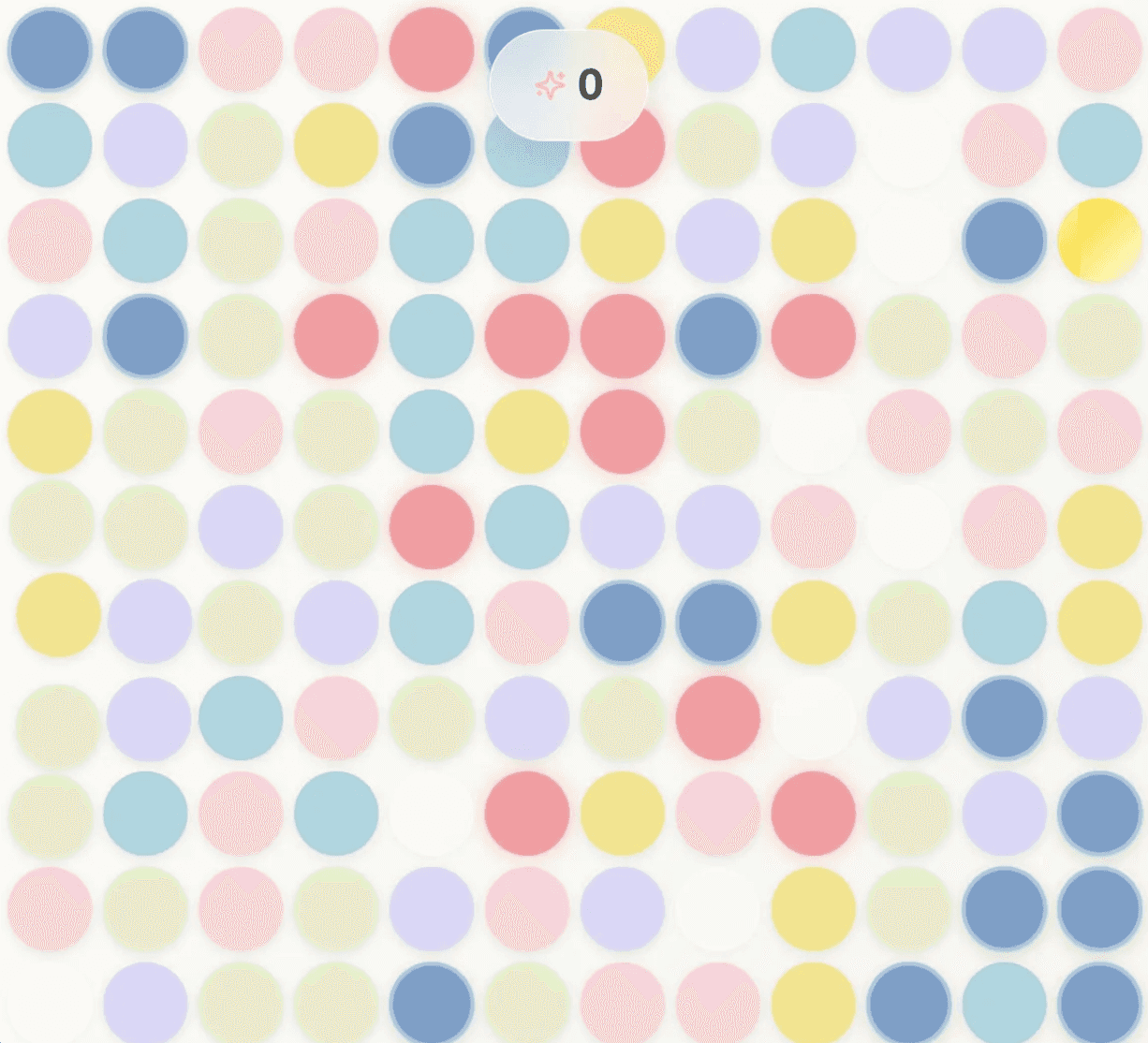

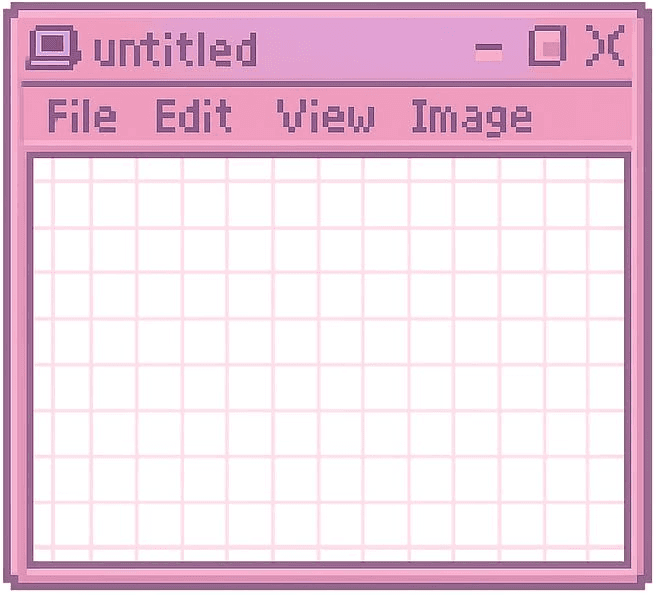
The turning point was learning to use negative constraints as aggressively as positive ones "don't use gradients," "don't let bubbles float freely," "don't round the OS window corners." Even then, the AI misread "pixel art" as a texture filter rather than a design system, applying scan lines to round modern bubbles. Genuine pixel art required defining every constraint explicitly. The rest came from manually sourcing and placing assets like the emoji, the landscape background. None of it was AI-generated.


Emergent AI made consistent mistakes on game logic. The clearest example: I specified that every regular bubble would award 10 points and special bubbles 30. The AI implemented random point values per bubble color instead — making the Speed mode scoring meaningless. No amount of re-prompting inside the builder fixed it reliably.


The solution was to stop trying to fix logic inside a visual builder and move it to where logic belongs: code. I used Claude to reason through the correct implementation, then made the changes myself directly in VS Code. Faster, more controllable, cleaner results.
This became the defining workflow insight of the project: use AI builders for visual iteration with fast feedback loops; use code tools for anything requiring precision. Knowing when to switch is itself a design skill.

game design and mechanics
visual design & aesthetics
The pastel bubble palette consisting of soft yellows, lavenders, pinks, greens, blues was chosen for its emotional register. High-saturation colors create urgency and tension. Pastels don't. Even in Speed mode, where the game is objectively stressful, the color palette keeps the experience feeling gentle. The visual world never fights the player's nervous system.
The special bubble appears briefly in different cells, it exists purely to reward attentive players with a moment of surprise and to signal that someone cared about this beyond the functional requirements.
The dreamy mountain and meadow landscape visible behind the OS window grounds everything in a soft, painterly world without a single word of instruction.


Three Modes for Three Mindsets & the tradeoff
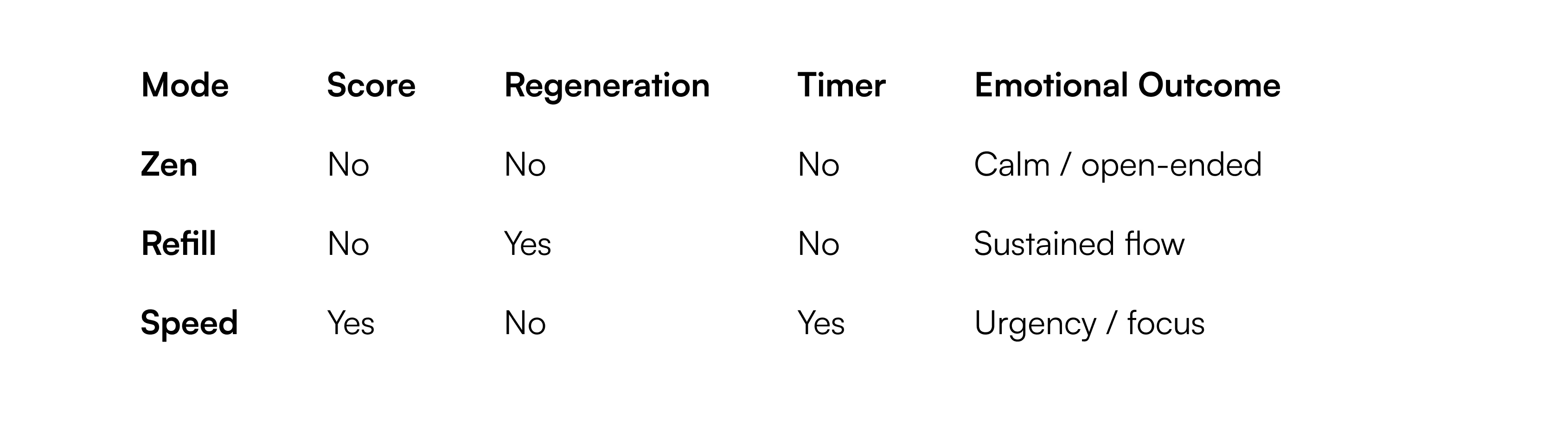
The most important design decision was building three completely separate modes rather than one universal game loop. Each serves a distinct emotional need, and the play test feedback confirmed these really do map to different types of people.
The core tradeoff in building three modes was complexity vs. coherence.
Three modes means three sets of UI states, three emotional registers to design for, and a risk that players feel overwhelmed before they've even started. The counter-argument and the reason I committed to it was that a single mode would have meant choosing which player to exclude. The mode tabs solve the decision upfront in a single tap, keeping the entry cost low while preserving the range.
Zen- Pop and breathe
No score. No timer. No pressure of any kind. The grid fills with pastel bubbles and you pop them at whatever pace feels right. Zen mode exists for the moments when you need your hands doing something gentle while your mind unwinds. The only metric is how you feel when you close the tab.
Design principle: remove every element that could trigger performance anxiety.
Refill- Endless flow
Bubbles refill continuously as you pop them, creating an unbroken meditative loop. The board never empties and never overwhelms. A bomb counter tracks earned power-ups, offering a light sense of progression without urgency.
Design principle: always something satisfying to do, never any pressure to hurry.
Speed- 30 seconds, chase your best
A countdown timer. A live score. A high score to beat. The same pastel bubbles that felt gentle in Zen now feel urgent, you're scanning for clusters, planning ahead, timing the bomb. Speed mode transforms the core mechanic into competition purely through time pressure.
Design principle: the mechanic doesn't change, only the context. Same bubbles, same grid, completely different emotional experience.


reward mechanics
Two mechanics sit on top of the core pop loop, each designed to reward without demanding. Together, the two mechanics create a light reward rhythm, the bomb for strategy, the gold bubble for serendipity- without adding complexity or instructions.
The Gold Bubble
Scattered across the grid, gold bubbles look different and behave differently. Pop one and instead of disappearing cleanly, it reveals a small pixel animal or emoji — a tiny moment of delight hidden inside an ordinary action. It does nothing for your score. It exists purely to surprise you. These small discoveries are what separate a game that feels made from one that feels generated.
The Bomb
Unlocked after a set number of pops, the bomb clears all adjacent same-color bubbles in one tap. A brief orange highlight previews the blast radius before detonation — so you can choose your moment. It's earned, not given, which means using it feels like a payoff rather than a shortcut. In Speed mode, timing it on a large cluster can make or break a high score run. In Refill and Zen, it's just a satisfying punctuation mark.
Playtesting and behavioral validation
(ongoing)
After achieving a stable implementation, I conducted playtesting sessions to evaluate whether the system produced the intended emotional experiences and interaction clarity.
Rather than asking players whether they liked the game, I focused on observing behavior.
I looked for:
• whether players understood interaction rules immediately
• how long they engaged without prompting
• whether different modes produced different interaction patterns
• whether scoring and rewards felt clear and fair
Players immediately understood the tap-to-pop interaction without instruction, confirming that the interaction model was intuitive.
In Zen Mode, players engaged more slowly and continuously, often remaining in the experience longer without focusing on outcomes. In Speed Mode, interaction patterns became faster and more aggressive, with players prioritizing score optimization.
This confirmed that system rules alone were sufficient to shift emotional tone, validating the core design hypothesis.
reflection- what did not work?
The most transferable lesson: AI tools don't have taste ,you bring the taste, and the tool executes.
The gap between the first output and the final product wasn't the AI getting smarter. It was the prompts getting more opinionated, the constraints getting tighter, and the willingness to step outside the tool entirely when it reached its limits.
Open prompts produce generic outputs
The AI did exactly what a generic prompt asked for and nothing more. The real design work was in the constraints: what to avoid, what the pixel grid should feel like, what not to render. Writing tight, opinionated prompts was the most important skill this project developed.
Do not rely solely on one AI builder
The scoring bug (random points per bubble instead of the specified 10/30 system) is the clearest example. Multiple re-prompts inside the builder didn't fix it. Moving the work to VS Code did. The lesson: recognise the tool's limits early and switch before you've wasted time on something it fundamentally can't do reliably.
"Pixel art" means nothing without definition
Prompting for pixel art produced a scan-line filter on round modern bubbles. The AI understood it as a texture, not a design system. Genuine pixel art required specifying every constraint — you can't prompt a visual language from a label alone.

next steps
Per-mode sound design The music toggle currently applies globally. The right version has distinct ambient tracks per mode- slower and atmospheric for Zen, a gentle loop for Refill, subtle rhythmic tension for Speed.
Speed mode difficulty variants 60-second and 15-second options alongside the current 30 seconds, giving Speed mode its own internal progression.
Combo multipliers Rapid successive cluster pops triggering a score multiplier, rewarding skilled play in Speed without touching Zen or Refill.
Mobile-native layout The current design is desktop-first. A mobile version with haptic feedback on pop would fit the stress-relief use case even more naturally.