Transforming a cultural experience marketplace from generic listings into Trusted, confident bookings.
Holiday World is an early-stage marketplace for holiday & cultural experiences, storytelling evenings, and hands-on traditions hosted by local communities.
While the broader product includes discovery, booking, and post-experience flows, this case study focuses specifically on the listing creation and listing experience system, the critical layer that connects organizers to guests.
role
Lead Product Designer
While I contributed across the product, this case study focuses on the listing system,
where I led the end-to-end design.
my contributions
Framed the core product problem
Designed and tested the initial MVP
Identified gaps through user behavior
Led the redesign into a structured, scalable system
cross- COLLABORATION
Founders & PMs
I helped define success metrics andshifted focus from listing quantity → listing quality
Engineers
Collaborated with them on structuring the multi-step systemand ensuring feasibility
User feedback & early product signals
Used interviews and behavioral patterns to guide iteration
status
Under development- Prototype validated with users
before

after

understanding the ecosystem

Research approach
assumption & building an MVP
To move quickly, we designed a simple listing creation flow focused on reducing friction. Organizers could input a title, description, pricing, media, and basic logistics.
the assumption
If we lower the barrier to creating a listing, organizers will naturally create rich, compelling content.
What we built
We designed a lightweight MVP focused on speed and ease:
Title and description
Pricing and media
Basic logistics
The goal was to:
Reduce friction
Increase supply quickly
Validate if organizers could self-express without guidance

testing the MVP & insights
We tested the MVP with real users and ran research across three channels- interviews with organizers, interviews with potential attendees, and internal data from early listing behavior and drop-off patterns.

insights from testing

What this meant for the product
At this point, we realigned the direction:
With PMs → from “increase listings” to “improve listing quality”
With engineering → feasibility of restructuring the flow
With user insights → identifying where guidance was needed most
This led to a fundamental shift:
From a flexible form → to a structured storytelling system
design principle
The listing flow should act less like a form and more like a conversation that draws out historical and cultural knowledge the organizer already has.
designing a guided storytelling system
7 step system
Instead of iterating on the same form, I redesigned listing creation as a structured, multi-step system. The goal wasn't just to collect information; it was to help organizers express their experience in a way that builds trust, step by step, in an order that makes sense for a guest to receive it.

Why this works
Breaks a complex task into manageable steps
Guides organizers without overwhelming them
Ensures every listing includes meaning, not just logistics

Key Design Decisions
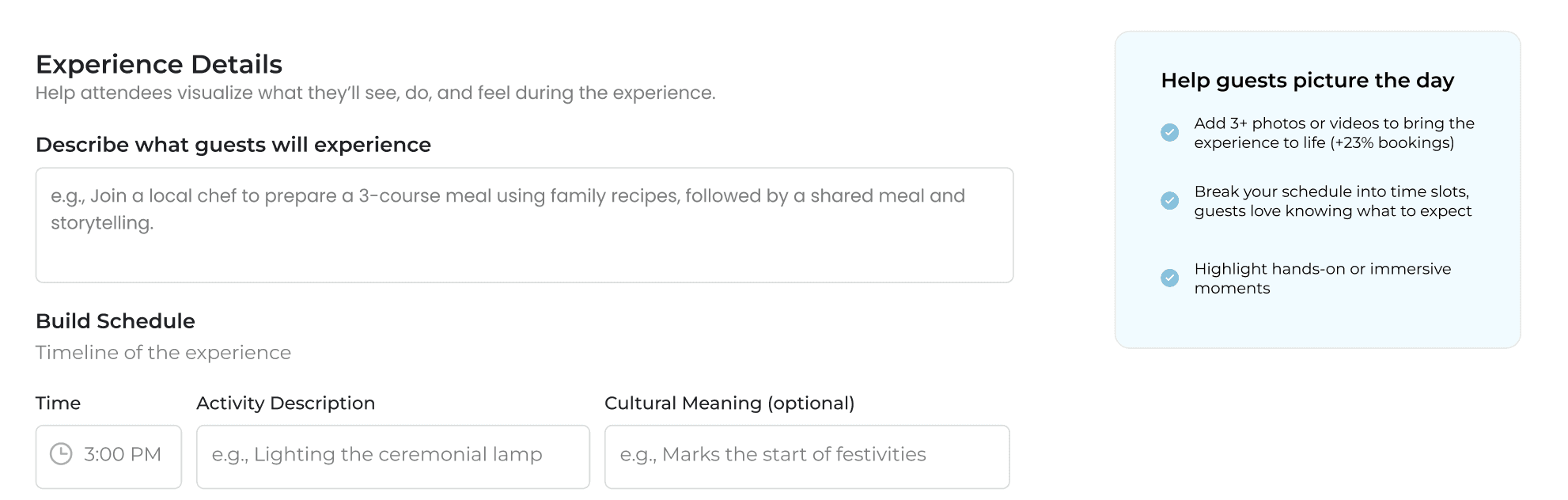
Guiding expression instead of asking for it
Problem:
Users didn’t know what to write in open-ended fields
Decision:
Replace large text inputs with guided prompts
What I designed:
Broke writing into smaller, structured questions
Used specific placeholders and examples to guide responses
Why it works:
Reduces blank canvas anxiety
Improves clarity and depth of responses
Helps organizers articulate without overwhelming them

Making cultural context visible
Problem:
Guests lacked the context needed to understand and trust experiences
Decision:
Introduce a dedicated “Cultural Identity” layer
What I designed:
Structured inputs around origin, meaning, and traditions
Dedicated section for explaining the experience in context
Why it works:
Bridges the knowledge gap between host and guest
Helps users feel more confident engaging with unfamiliar experiences
Structuring trust progressively
Problem:
Trust gaps only became visible after listings were published
Decision:
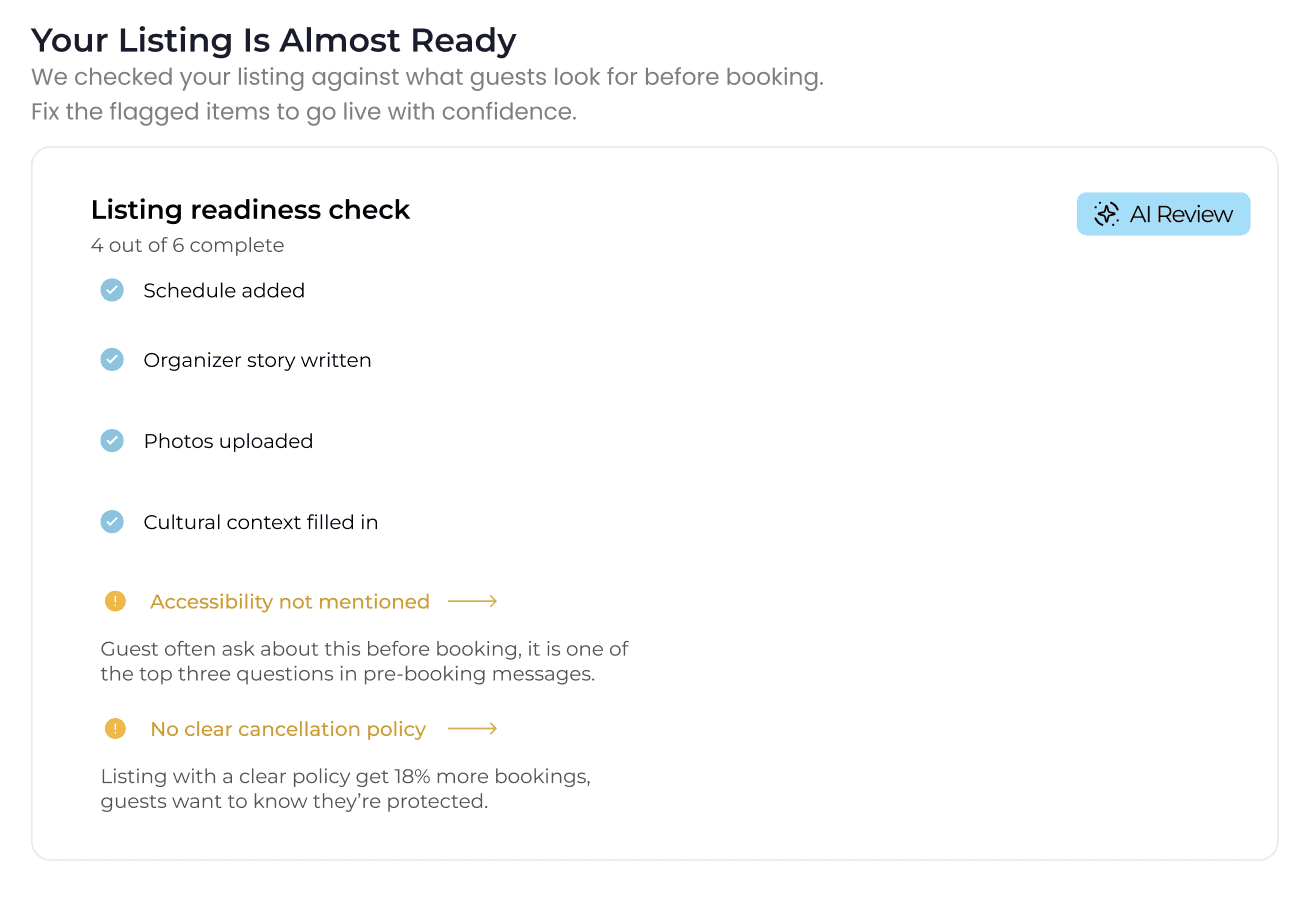
Introduce a validation layer before publishing
What I designed:
A listing readiness checklist
An AI-assisted validation layer that identifies missing trust signals (e.g., accessibility, expectations, key details)
Why it works:
Surfaces gaps before users encounter them
Improves listing quality proactively
Reduces uncertainty during booking
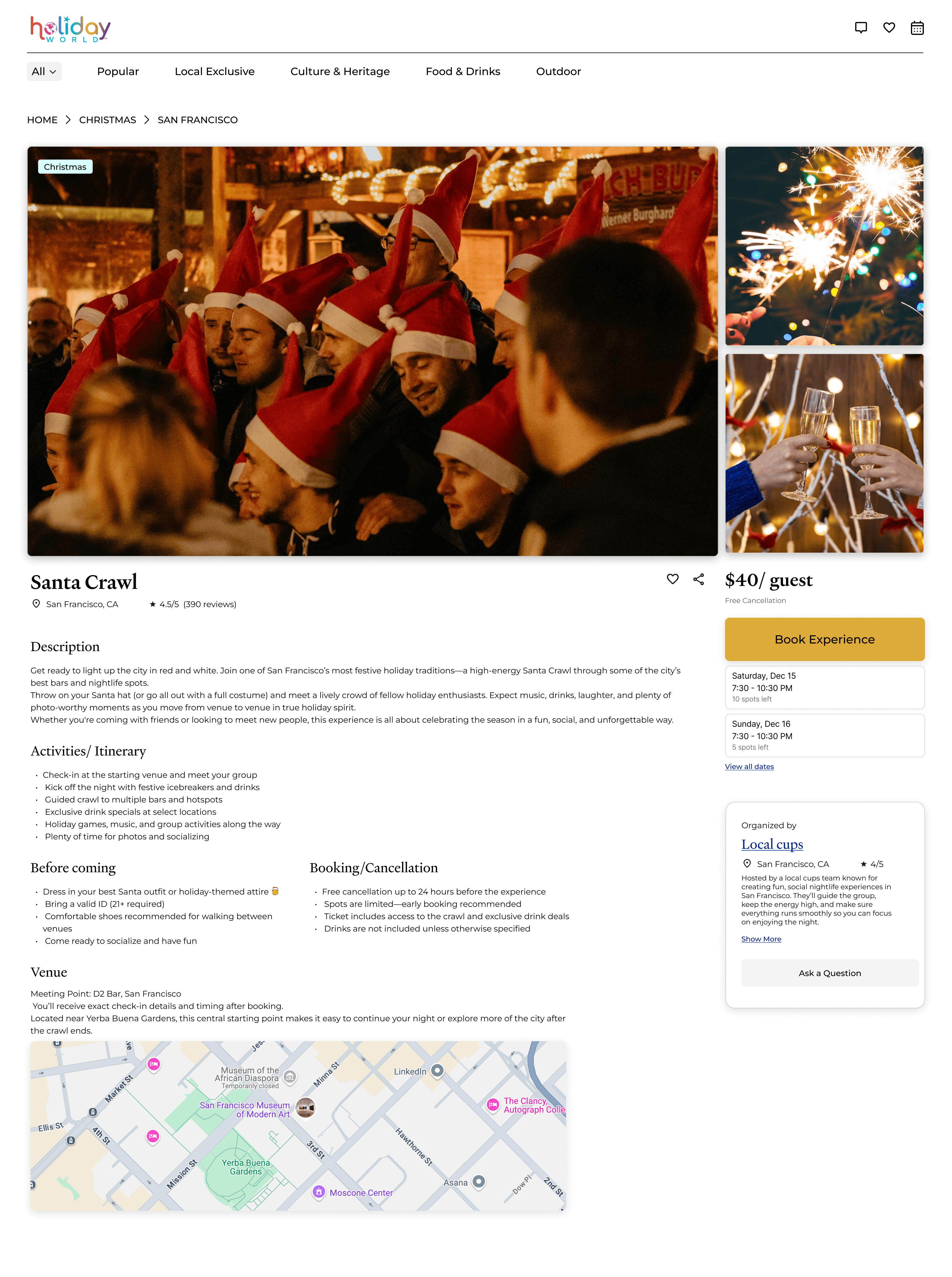
The listing page is the payoff of the system
Every section of the creation flow maps to a corresponding trust-building block on the listing page. The organizer's structured input becomes a rich, readable experience.
I also added one AI feature on the attendee side- a personalized preview card that surfaces above the fold, bridging the guest's browsing history to the specific experience. It references what the guest has saved or viewed, and surfaces a warm, specific reason to book.


What validation showed us
We tested the redesigned flow with users to understand how it changed behavior.
Organizers expressed more with less effort
Structured prompts helped move from short, logistical descriptions to more meaningful contentReduced friction during creation
Breaking the flow into steps made it easier to progress without hesitationListings became more differentiated
Cultural context and personal stories made each experience feel distinctImproved clarity for guests
Users could better understand and evaluate experiences before bookingTrust gaps surfaced earlier
The validation layer helped identify missing information before publishing
reflection
This project shifted how I think about designing forms.
What started as a listing flow turned out to be a problem of translation between what organizers know and what guests need to trust.
I learned that good design doesn’t just make input easier; it shapes how information is expressed and understood across the system.
Working in an early-stage environment also meant balancing speed with clarity, shipping quickly, learning from real behavior, and evolving the product in collaboration with PMs and engineers.