TwinMind ios app
Re-designing for Visible Cognition & trust
TwinMind is an AI-powered “second brain” that listens, observes, and assists in real time across meetings, lectures, browsing, and everyday thinking. It can summarize conversations, answer questions from your context, and proactively suggest what to do or say next.
Despite its capabilities, its intelligence often feels invisible; users receive outputs without understanding how or why they were generated. This project explores how Twinmind can be redesigned to make AI thinking visible, continuous, and human-centered.
Know more about Twinmind here- https://twinmind.com/
role
AI Product Designer
type
5 day design sprint
Deliverables
Hi-fi screens + prototype
When intelligence becomes invisible
The problem & opportunity
TwinMind positions itself as an AI “second brain” that can capture conversations, summarize information, and assist in real time. However, in its current experience, the intelligence feels fragmented and opaque.

App screens from october 2025

Home- Information is surfaced across sections, but lacks a clear sense of connection or continuity.

Capture- The system begins recording, but provides no clear feedback on active processing and understanding.

Questions- AI suggestion appear while recording, but feel disconnected from user intent and context.

Notes- Summaries present information, but don’t reveal how insights are derived or prioritized.

Transcript- Raw transcripts capture everything, but don’t help users identify what actually matters.

AI Chat- Answers are generated on demand, but the system’s thinking remains opaque and isolated.
Key Insight
Gap Identified
Design challenge & Principles
How might we make TwinMind feel intelligent through visible cognition and continuity of understanding?
The redesign was about surfacing the intelligence that already existed, making the AI's reasoning legible at every stage of use, from live capture to long-term reflection.
I chose not to redesign the existing navigation structure, but to replace it entirely with a hierarchy that matched how cognition actually works. This was the biggest conceptual bet of the sprint.
Four principles shaped every decision:

Solution framework
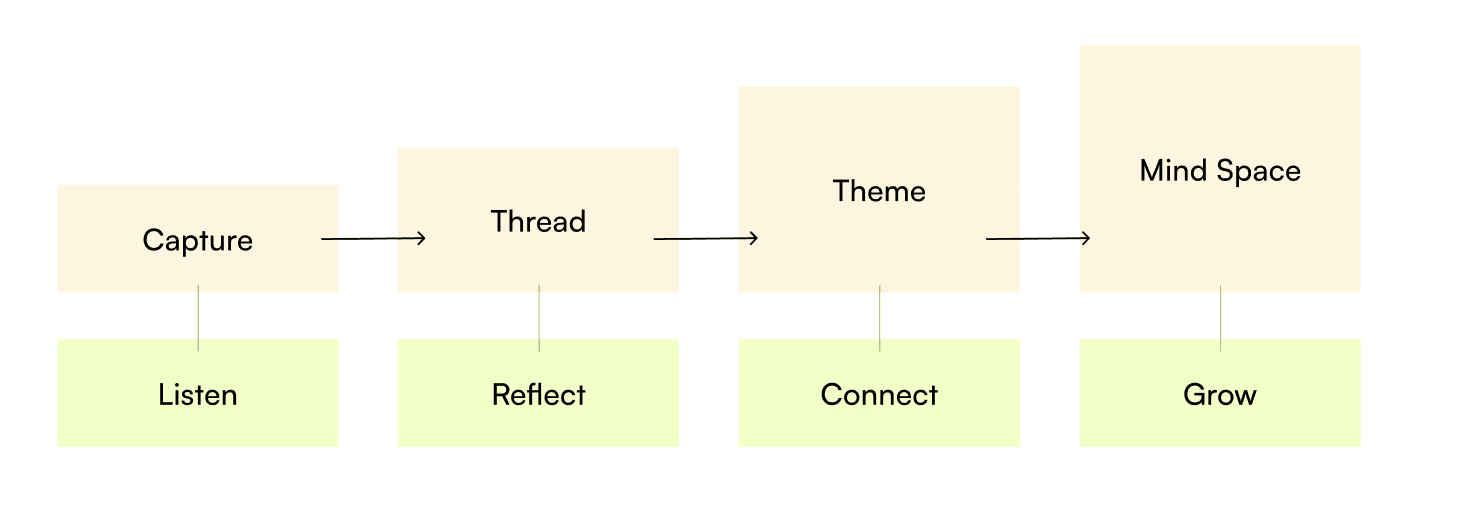
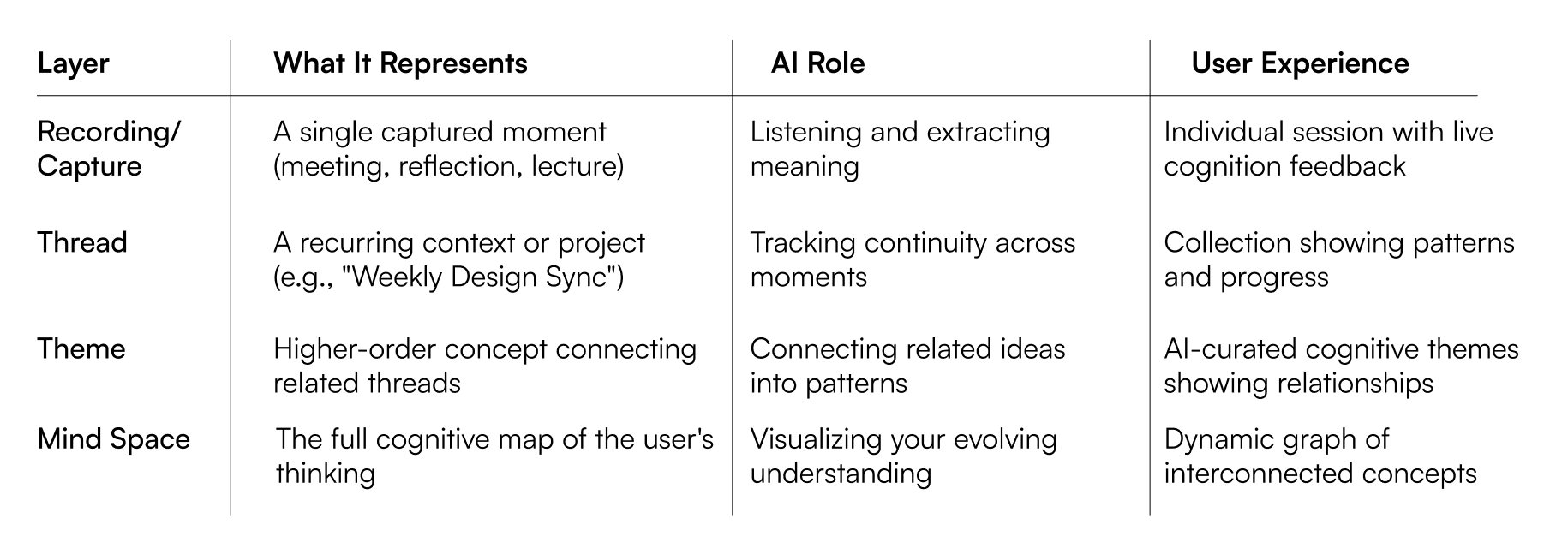
A four-layer cognitive architecture
I designed TwinMind to mirror how humans think, from momentary awareness to conceptual understanding. Each layer builds on the last, creating a continuous sense of growing intelligence rather than isolated AI outputs.
Visual Design: Making Cognition Feel Alive
The visual language was designed to reinforce the idea of visible, evolving intelligence, not just to look modern, but to communicate how the system thinks and learns.
Dark Interface as Cognitive Space
Gradients as a visual thread of thought
Gradients act as a semantic layer across the system.
Each theme is represented by a distinct gradient
Gradients persist across related threads and insights
Visual continuity links ideas across contexts
Visual Consistency Across the System
The same visual language flows across:
Capture → Threads → Themes → Mind Space
This ensures:
Users don’t have to relearn patterns
The experience feels unified
The system feels like a single evolving entity


key screens & app flow
home screen
Serves as a cognitive dashboard: blending structure (To-dos, Milestones) with awareness (Themes, Threads, Recordings).
Surface-level AI cognition: uses labels like Evolving and Emerging to signal active processing.
Continuous narrative: every section connects to the next, building a sense of ongoing thought.
Encourages users to feel TwinMind thinking alongside them, not only organizing or producing data.
capture
Transforms recording into an active, intelligent interaction.
Real-time text feedback (“Noting patterns and key ideas…”) makes AI perception tangible.
Waveform and subtle motion create calm cognitive presence during live capture.
Tabs (Transcript / Get Answers / Take Notes) connect listening with immediate meaning-making.

threads
Group multiple recordings into context-rich narratives.
Each thread acts like a memory, summarizing what the AI recognized (“Decisions around layout and visuals”).
Mirrors human cognition - layered, temporal, and associative.
Encourages reflection through AI-generated questions and contextual insights.
theme
Shows AI synthesis across multiple threads and contexts. The user can add related threads to create a theme.
Cards like Evolution, Breakthroughs, and Connected Ideas reveal how understanding grows.
Visualizes how the system is making sense of recurring ideas, not just storing them.
Reinforces emotional trust by showing visible awareness and reasoning.
mind space
A visual map of evolving cognition through overlapping circles for themes, gradients for activity.
Represents the relationship between human reflection and AI learning.
Gentle motion and light gradients convey living intelligence and emotional calm.
Provides meta-awareness, users can see their own thinking architecture.

Expected Outcomes
Visible Intelligence
Users understand how AI arrives at insightsContinuity of Thought
Ideas connect across time and contextEmotional Trust
Transparency builds confidence and reliabilityAdaptive Learning
The system becomes more personalized with use

reflection
This project shifted my perspective from designing AI features to designing cognitive experiences.
Key learnings:
Intelligence about perception and trust.
Making systems understandable is as important as making them powerful and accurate.
Designing for AI requires thinking in systems, not just screens.
If I were to take this further, I would:
Validate concepts through user testing
Explore motion and interaction prototypes in depth
Measure how visible cognition impacts trust and retention
conclusion
The TwinMind redesign transforms AI from an invisible assistant into a visible thinking partner.
By surfacing reasoning, designing for continuity, and enabling reflection, the experience becomes more human, intuitive, and trustworthy by creating a system that understands, evolves, and grows with the user.